Ask questions grounded in real situations
Observe and interview customers and employees to understand their difficulties. Separate facts from assumptions, then judge where AI could help.

Design Thinking × AI
Start with real needs. Use AI to explore possibilities. Turn shared ideas into prototypes people can test.
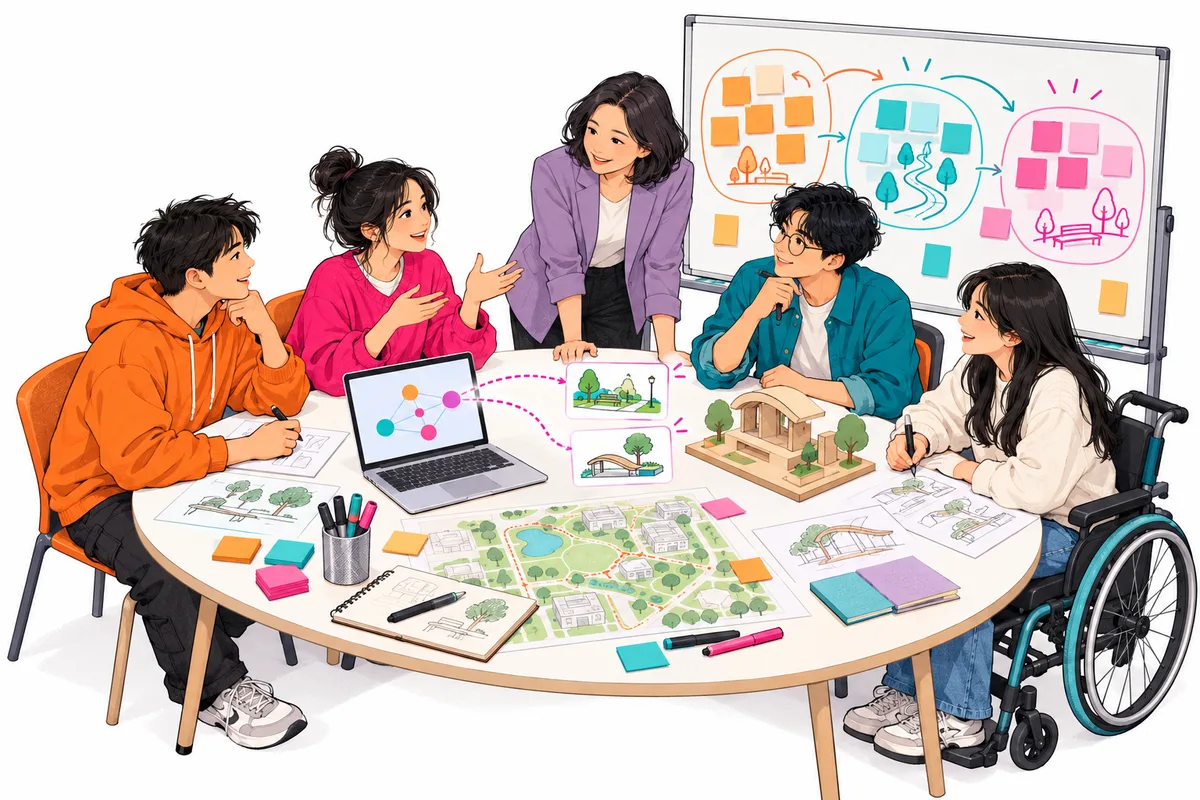
01 — A direction for transformation
Adopting tools is the beginning. Transformation changes employee workflows, customer experiences and organizational decisions.
Which problems deserve AI? Where does human judgment matter? How do new ways of working earn trust? Design thinking brings these questions into research, co-creation and experiments.
Observe and interview customers and employees to understand their difficulties. Separate facts from assumptions, then judge where AI could help.
Understand people’s abilities, needs and concerns. Define AI’s role, human decisions and points of intervention.
Use small prototypes and pilots to test practical outcomes, usability and business value before expanding.
Bring different roles into defining problems and exploring solutions to build shared understanding through practice.
02 — The design thinking mindset
Practice curiosity, empathy and experimentation through specific actions. AI helps organize and expand thinking; people gather evidence, make choices and reflect.
Record what you notice before asking AI to help you investigate.
Form your own ideas before using AI to expand the possibilities.
Test with real participants and explain your conclusions with evidence.
Make time to observe and listen, use AI to explore alternatives, then return to real evidence to decide.
Meet people and listen before drawing conclusions. AI can organize authorized research records; check its summaries against what participants actually said.
Write down what you do not know. Ask AI for alternative explanations and counterexamples, then investigate them rather than treating suggestions as facts.
Compare how different people experience the situation. Use AI to suggest other ways to frame the challenge; the team chooses a focus supported by evidence.
Keep a visible list of facts, assumptions and open questions. AI can help organize the list; people decide which uncertainty to investigate next.
State what you want to learn before making a prototype. Use AI to draft it, then observe real people trying it and record what happens.
Invite different roles to contribute and retain disagreements. AI can summarize perspectives; participants check the summary and make decisions together.
Compare expectations with observations. AI can highlight differences; explain which evidence changed your judgment and how the next version responds.
AI can simulate perspectives. Real empathy comes from contact with people. AI-generated insights and suggestions need evidence and human judgment.
03 — Six stages, continuous learning
Begin by understanding the question. Gather evidence, explore options and test ideas. Each stage makes human responsibility and AI’s contribution clear.
Observe a situation, record your questions and separate facts from assumptions.
Help formulate follow-up questions, unpack assumptions and identify gaps.
Begin with your own observations before asking AI for solutions.
Observe real situations, interview people and listen carefully.
Refine interview questions and organize records shared with permission.
Simulated users cannot replace evidence from real people.
Compare evidence, explain differences and choose the research focus.
Cluster information, suggest alternative explanations and check reasoning.
People remain responsible for the final problem definition.
Think independently first, then discuss options and explain your choices.
Expand directions, offer analogies and explore different constraints.
Agree on selection criteria; do not delegate the decision to AI.
Decide what to test and how much detail the prototype needs.
Draft storyboards, scripts, interfaces or working demonstrations.
Build enough to test the question; visual polish is secondary.
Invite real participants, observe behavior and decide what to change.
Organize feedback, compare outcomes and identify patterns.
Conclusions need real evidence; AI cannot substitute for testing.
Testing can change the question. Return to research or problem framing whenever the evidence calls for it.
Explain what you have noticed and what you do not yet know. Use AI to challenge your initial framing, then decide what to investigate.
Initial question, assumptions and a research plan.
Human judgmentBegin with your own observations before asking AI for solutions.
Prepare open questions, obtain consent and document people’s own words. Check AI summaries against the original records and seek out different experiences.
Field notes, interview records and follow-up questions.
Human judgmentSimulated users cannot replace evidence from real people.
Compare observations across stakeholders. Distinguish recurring patterns from isolated comments, document uncertainty and explain why this problem deserves attention.
An evidence-backed problem statement and unresolved questions.
Human judgmentPeople remain responsible for the final problem definition.
Generate initial ideas before using AI. Compare cultural or user value, practical constraints and feasibility; record which ideas were rejected and why.
Several concepts, comparison criteria and reasons for selection.
Human judgmentAgree on selection criteria; do not delegate the decision to AI.
Choose the smallest experience that can test a key assumption. Use AI to help build it, review the content and prepare tasks participants can try.
A testable prototype, tasks and a feedback plan.
Human judgmentBuild enough to test the question; visual polish is secondary.
Compare results with your initial assumptions and agreed criteria. Keep contradictory feedback and return to earlier stages when the evidence changes your understanding.
Test records, changes and the evidence behind them.
Human judgmentConclusions need real evidence; AI cannot substitute for testing.
04 — Co-create the change
Bring the people affected by a challenge into the same conversation: employees and customers in an organization, or teachers, students and project partners in a course. AI supports documentation and exploration so the group can spend more time listening, questioning and deciding together.
Young participants: what helps someone understand and take part?
Practitioners: which meanings and practices need careful explanation?
Could a practitioner-led experience connect cultural meaning with hands-on participation?
AI groups research notes. The team checks evidence, differences and unanswered questions.
Hear the story · reviewed with practitioners
Try the practice · observe participation
Pilot with practitioners, community partners and young participants. Check understanding, experience and operating effort.
Illustrative questions, hypothesis and prototype; not interview findings or completed project results.
Use AI to organize research, interviews and business materials, surface preliminary clues and open questions, and help prepare the agenda and activities. Bring traceable evidence into the room.
Cluster notes, summarize discussion, propose alternatives and generate storyboard or prototype sketches. Anonymous input and perspective summaries can help more voices enter the conversation. Participants choose and decide together.
Organize concepts, decision rationale and unresolved questions. Help create experiment plans, responsibilities and follow-up materials so teams know what to validate next and how to measure it.
Workshop outcomes belong to the participants. Check AI’s summaries with the team, retain minority views and unresolved disagreements, and protect personal information in research materials.
05 — From understanding to action
A focused Design Thinking × AI workshop helps your team turn shared learning into concrete next steps.
AIDT for higher education
AI is changing how knowledge is accessed and redefining the capabilities graduates need. Higher education in China faces a new challenge: helping students understand real needs, ask valuable questions, cross disciplinary boundaries and turn knowledge into actions and outcomes that can be tested.
Artificial Intelligence Design Thinking (AIDT) brings artificial intelligence and design thinking together: human needs set the direction, real projects organize learning, AI expands exploration, and sustained practice builds judgment and creativity.
Strategic partnership
WorkspaceX and the School of Design Thinking, Communication University of China are strategic partners. Together, we bring design thinking in education, the exploration of CUC AIDT Lab — AI⁺ Future Creativity Lab, and human–AI collaboration into a shared initiative. Our collaboration focuses on courses, faculty development, workshops and real projects to develop an AIDT teaching model that can be practiced, evaluated and continually improved.
Connect classrooms with society and disciplines with meaningful problems. Let teachers and students learn through creating together.
An interdisciplinary team can connect design, communication, social research and technology in one project. Teachers guide research quality; project partners contribute their experience and help evaluate the work.
Illustrative project
How might we work with heritage practitioners, communities and young people to design a public cultural service that balances cultural accuracy, participation and operational feasibility?
Ask how cultural meaning, participation and practical operation can work together. Record assumptions before proposing a solution.
Learn from practitioners, community partners and young people; record consent, sources and differing views.
Map needs and tensions, then support the chosen problem with research evidence.
Compare an exhibition, a guided experience and a digital story using cultural accuracy, participation and operating effort.
Prototype a story, a hands-on activity and the service flow; review cultural content with practitioners.
Observe real participation and understanding. Record partners’ operating effort and explain what the next version changes.
Teaching project example illustrating the AIDT learning process; not a completed university partnership project.
Ask how cultural meaning, participation and practical operation can work together. Record assumptions before proposing a solution.
Learn from practitioners, community partners and young people; record consent, sources and differing views.
Map needs and tensions, then support the chosen problem with research evidence.
Compare an exhibition, a guided experience and a digital story using cultural accuracy, participation and operating effort.
Prototype a story, a hands-on activity and the service flow; review cultural content with practitioners.
Observe real participation and understanding. Record partners’ operating effort and explain what the next version changes.
Each stage leaves a traceable learning record: how the problem was understood, why a solution was chosen and how the team changed its judgment all become part of teaching.
Design thinking gives AI use a direction. Empathy asks who technology affects. Curiosity invites better questions. Openness and collaboration help disciplines develop shared understanding. Experimentation encourages early testing, while reflection helps students recognize bias and take responsibility.
AI can help students form more hypotheses, compare more possibilities and receive timely feedback. Students must verify information, explain their choices and take responsibility for their work. Real interviews, field observation and user feedback remain essential evidence for learning.
Design thinking workshops connect teachers, students, industry partners and real users around a shared challenge and a direction for action.
Before a workshop, AI helps organize background material and research tasks. During it, AI supports documentation, synthesis, new perspectives and rapid prototyping, leaving more time for listening, questioning and creating together. Afterwards, AI helps organize action plans, track experiments and synthesize feedback so classroom ideas can develop through practice.
Teachers guide learning, uphold research quality and facilitate reflection. Teams make the key decisions together.
Our collaboration focuses on four directions.
Bring real challenges, interdisciplinary collaboration and prototype testing into course design.
Help teachers design project tasks, facilitate human–AI collaboration and develop assessment for the AI era.
Enable students to explore with real project stakeholders and discover the practical value of their disciplinary knowledge.
Document project processes, learning evidence and teaching reflections to build resources that can be reused and continually improved.
Assess question quality, use of evidence, reasons for selecting a solution, collaboration, iteration and individual reflection alongside the final work. At stage reviews, students explain what they did, where AI helped, which suggestions they rejected and what evidence changed their judgment.
WorkspaceX provides a shared workspace for this journey, connecting project materials, team discussions, AI collaboration, prototypes and assessment feedback so teachers and students can keep projects moving.
Start with a real challenge, a project course or a teacher–student co-creation workshop to explore learning for the AI era in Chinese higher education.
Start with a meaningful challenge
Invite your team to explore AI’s possibilities. Let design thinking guide the direction, AI strengthen insight and action, and real human needs shape every step.
Design a co-creation workshop around your team’s goals. Email us at hello@boardx.us.